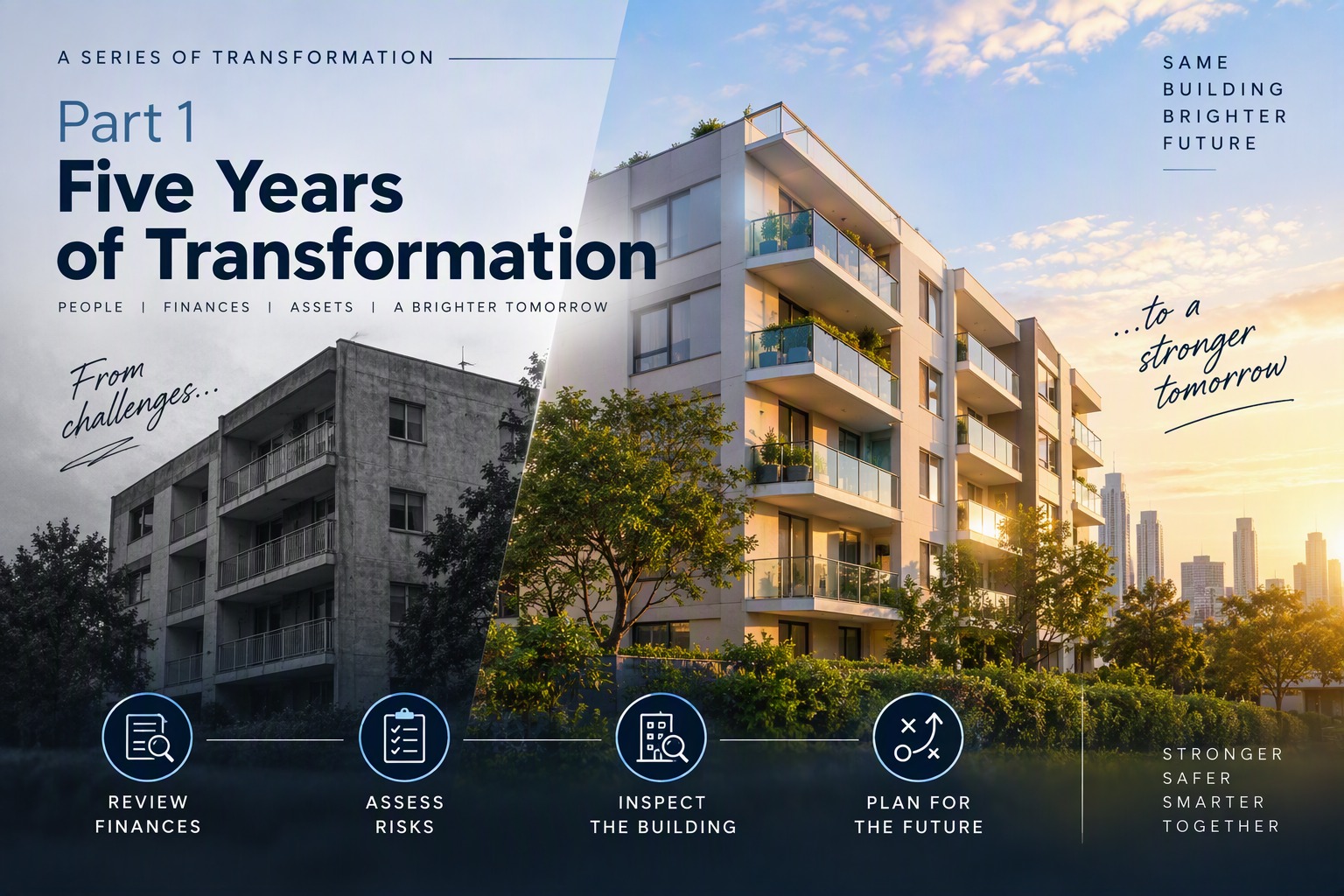
When I first took on the role of Chairman of our strata committee, I quickly realised that managing a residential building is not unlike running a small business. The building had a rich history, a diverse group of residents, and a growing list of challenges that had accumulated over time. While there was no single crisis demanding immediate attention, there was a clear need for a strategic approach to ensure the property's long-term financial and physical sustainability.
Looking back now, five years later, the scale of the transformation is remarkable. What began as a review of finances evolved into a comprehensive programme of improvement that touched almost every aspect of the building's operations, maintenance, technology, and long-term planning.
One of the first lessons I learned was that meaningful change starts with understanding the numbers.
Too often, building committees focus on the most recent budget or the latest invoice without stepping back to identify broader trends. My first task was to gather several years of financial reports and undertake a detailed analysis of expenditure patterns. By reviewing historical spending across all categories, it became possible to identify where money was being consumed, which costs were increasing, and which areas offered opportunities for optimisation.
This exercise revealed far more than individual line items. It provided insight into the overall health of the building and highlighted opportunities to improve efficiency, strengthen financial controls, and reduce unnecessary expenditure.
From this analysis, we developed a structured roadmap of financial improvements:
- Short-term initiatives focused on addressing obvious inefficiencies, improving contractor management, and eliminating avoidable costs.
- Medium-term initiatives concentrated on upgrading systems, improving operational processes, and delivering measurable reductions in ongoing expenditure.
- Long-term initiatives were designed to position the building for future sustainability, minimise lifecycle costs, and ensure that major projects could be delivered without placing unexpected financial pressure on owners.
However, reviewing finances alone is not enough.
A building's financial position can only be properly understood when considered alongside its physical condition. A healthy bank balance today may simply be disguising significant liabilities that have not yet surfaced.
For this reason, one of the next priorities was to conduct a comprehensive inspection of the building and assess its major assets and infrastructure. Plant rooms, pumps, electrical systems, fire safety equipment, lifts, common property assets, and building fabric all required review.
The objective was straightforward: identify risks before they became failures.
Coming next: From Reactive to Proactive. How risk mitigation, asset planning, and early intervention changed the building's operating model and significantly reduced the frequency of costly surprises.